TRINA: Safety-Critical Autonomy for Future Mobility
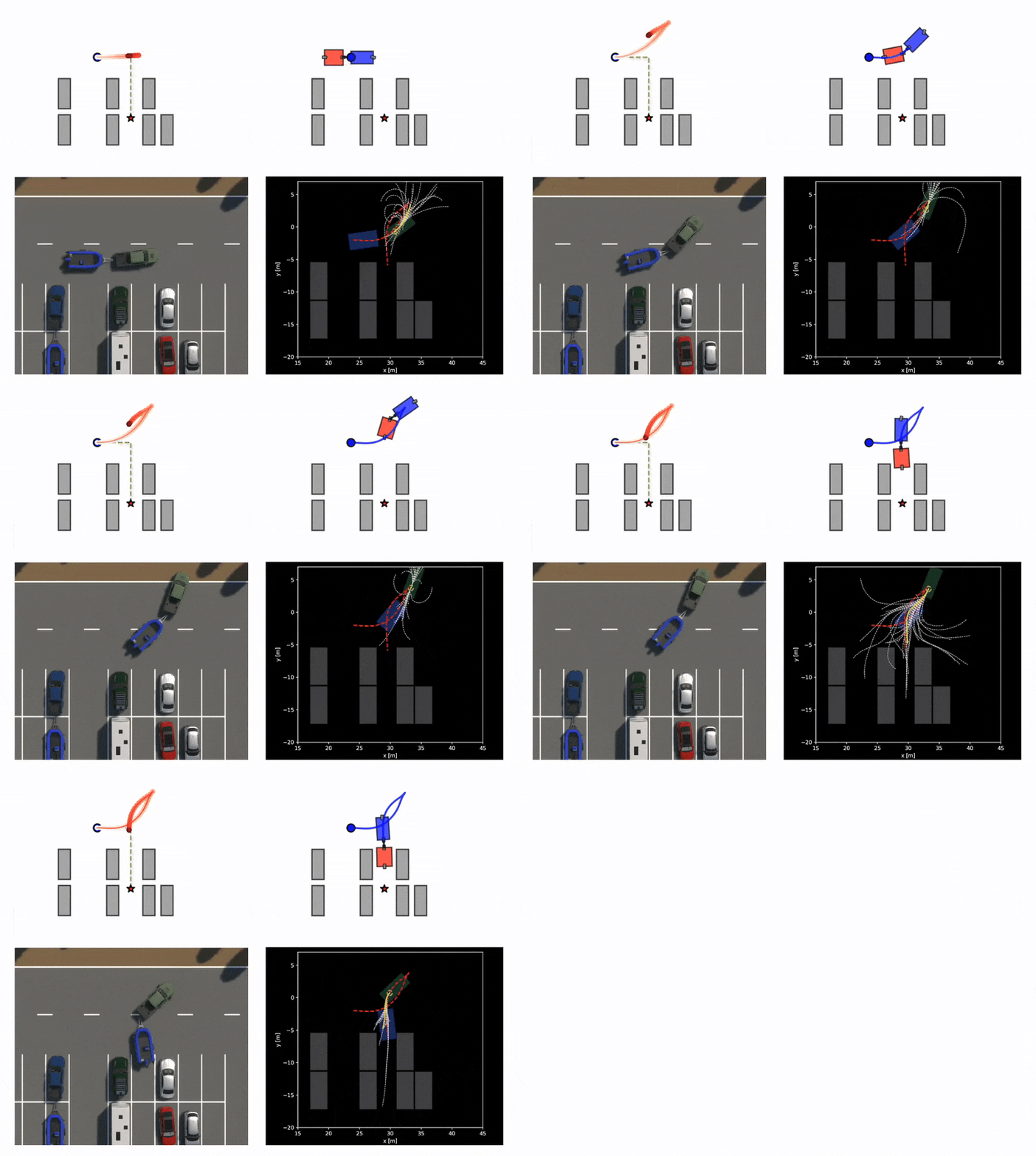
The Toyota Research Institute of North America (TRINA) conducts fundamental research in advanced technologies for future mobility, including autonomous systems, robotics, and intelligent control. Our research supported by TRINA focuses on safety-critical planning and control for next-generation autonomous mobility and robotic systems, including autonomous vehicles, articulated tractor-trailer systems, indoor mobile robots, and aerial platforms. These systems must operate reliably in complex and dynamic environments while accounting for nonlinear dynamics, physical constraints, limited sensing, and uncertainty in the surrounding environment. We investigate how control theory, optimization, and machine learning can be integrated to develop autonomous systems that are both capable and safety-aware. Our research addresses three interconnected challenges:
- Planning and control for complex robotic systems: developing computationally efficient methods for motion planning, trajectory optimization, and feedback control that enable autonomous systems to perform challenging maneuvers while satisfying dynamical and operational constraints.
- Safety assurance under uncertainty: establishing formal methods for verifying and enforcing safety requirements in environments with uncertain dynamics, imperfect sensing, and unpredictable interactions, leveraging safety-critical control and mathematical guarantees.
- Safe integration of learning and optimization: combining model predictive control, reinforcement learning, and generative robot policies with control-theoretic safety mechanisms to improve autonomous decision-making while maintaining explicit safety constraints.
Together, these efforts aim to advance the foundations of trustworthy, high-performance autonomy, enabling robotic systems to operate safely and effectively beyond controlled environments.
Recent work includes diffusion planning with safety shielding, parallel policy-library safety filters, barrier-rate guided MPPI, and reinforcement learning with differentiable CVaR safety layers. These papers and their open-source implementations are linked below. Try the DiffCVaR web demo to explore risk adaptation in uncertain crowds.
People
Principal Investigator

Current Members
Alumni

Hardik Parwana
Role: PhD Robotics (2020 - 2024)
Now: Robotics Engineer @ Applied Intuition
link / email /
Papers
- DiffCVaR: Reinforcement Learning for Risk Adaptation via Differentiable CVaR Barrier FunctionsIEEE RA-L 2026 / ICRA 2027
project page / video / code / web demo / arxiv / - Policy Library CBF: Finite-Horizon Safety at Runtime via Parallel RolloutsPreprint, 2026
project page / video / code / arxiv / - Safe Model Predictive Diffusion with ShieldingIEEE ICRA 2026
abstract / project page / video / code / arxiv /Generating safe, kinodynamically feasible, and optimal trajectories for complex robotic systems is a central challenge in robotics. This paper presents Safe Model Predictive Diffusion (Safe MPD), a training-free diffusion planner that unifies a model-based diffusion framework with a safety shield to generate trajectories that are both kinodynamically feasible and safe by construction. By enforcing feasibility and safety on all samples during the denoising process, our method avoids the common pitfalls of post-processing corrections, such as computational intractability and loss of feasibility. We validate our approach on challenging non-convex planning problems, including kinematic and acceleration-controlled tractor-trailer systems. The results show that it substantially outperforms existing safety strategies in success rate and safety, while achieving sub-second computation times. - Safe Navigation in Uncertain Crowded Environments Using Risk Adaptive CVaR Barrier FunctionsIEEE IROS 2025
abstract / project page / video / code / arxiv /Robot navigation in dynamic, crowded environments poses a significant challenge due to the inherent uncertainties in the obstacle model. In this work, we propose a risk-adaptive approach based on the Conditional Value-at-Risk Barrier Function (CVaR-BF), where the risk level is automatically adjusted to accept the minimum necessary risk, achieving a good performance in terms of safety and optimization feasibility under uncertainty. Additionally, we introduce a dynamic zone-based barrier function which characterizes the collision likelihood by evaluating the relative state between the robot and the obstacle. By integrating risk adaptation with this new function, our approach adaptively expands the safety margin, enabling the robot to proactively avoid obstacles in highly dynamic environments. Comparisons and ablation studies demonstrate that our method outperforms existing social navigation approaches, and validate the effectiveness of our proposed framework.