CAAMS: Center for Autonomous Air Mobility and Sensing
The Center for Autonomous Air Mobility and Sensing (CAAMS) is an NSF Industry-University Cooperative Research Center that brings together universities, industry, and government to address the core technical challenges of autonomous air mobility, from assured autonomy and AI for aviation to unmanned aircraft systems and sensing. The University of Michigan joined CAAMS in 2023, with Prof. Dimitra Panagou serving as the UM site director.
Our work in CAAMS, Tactics in SWARMS for Trusted Foundational Autonomy (System-Wide Adversarially-Robust Multi-Agent Systems), develops methods for safety-critical control under different classes of uncertainty:
- Nominal mission planning: multi-objective planning of probabilistically safe trajectories in stochastic environments with reactive obstacles.
- Safety verification (gatekeeper): distributionally robust safe planning and control for systems with hard-to-model, non-Gaussian, nonlinear stochasticity, which runs in real time on high-dimensional systems such as an F-16 fighter jet and a racecar.
- Estimation, adaptation, and uncertainty quantification: safe online adaptation and conformal-prediction-based uncertainty quantification for learning-enabled controllers, integrated with control barrier functions and MPC.
- Multi-agent safety: decentralized planning and safety filters that remain safe despite noisy dynamics, restricted communication, and impaired localization, with applications to urban air mobility, search and rescue, and contested environments.
People
Principal Investigator
Current Members


Alumni

Papers
- Distributionally Robust Safety Under Arbitrary Uncertainties: A Safety Filtering ApproachWe study how to ensure probabilistic safety for nonlinear systems under distributional ambiguity. Our approach builds on a backup-based safety filtering framework that switches between a high-performance nominal policy and a certified backup policy to ensure safety. To handle arbitrary uncertainties from ambiguous distributions, i.e., where the distribution is not of specific structure and the true distribution is unknown, we adopt a distributionally robust (DR) formulation using Wasserstein ambiguity sets. Rather than solving a high-dimensional DR trajectory optimization problem online, we exploit the structure of backup-based safety filtering to reduce safety certification to a one-dimensional search over the switching time between nominal and backup policies. We then develop a sampling-based certification procedure with finite-sample guarantees, where empirical failure probabilities are compared against a Wasserstein-inflated threshold. We validate our method across three systems, from a Dubins vehicle to a high-speed racing car and a fighter jet, demonstrating the broad applicability and computational efficiency.
- Adaptive Control Allocation for Underactuated Time-Scale Separated Non-Affine SystemsMany robotic systems are underactuated, meaning not all degrees of freedom can be directly controlled due to lack of actuators, input constraints, or state-dependent actuation. This property, compounded by modeling uncertainties and disturbances, complicates the control design process for trajectory tracking. In this work, we propose an adaptive control architecture for uncertain, nonlinear, underactuated systems with input constraints. Leveraging time-scale separation, we construct a reduced-order model where fast dynamics provide virtual inputs to the slower subsystem and use dynamic control allocation to select the optimal control inputs given the non-affine dynamics. To handle uncertainty, we introduce a state predictor-based adaptive law, and through singular perturbation theory and Lyapunov analysis, we prove stability and bounded tracking of reference trajectories. The proposed method is validated on a VTOL quadplane with nonlinear, state-dependent actuation, demonstrating its utility as a unified controller across various flight regimes, including cruise, landing transition, and hover.
- Autonomy Architectures for Safe Planning in Unknown Environments Under Budget ConstraintsMission planning can often be formulated as a constrained control problem under multiple path constraints (i.e., safety constraints) and budget constraints (i.e., resource expenditure constraints). In a priori unknown environments, verifying that an offline solution will satisfy the constraints for all time can be difficult, if not impossible. We present ReRoot, a novel sampling-based framework that enforces safety and budget constraints for nonlinear systems in unknown environments. The main idea is that ReRoot grows multiple reverse RRT* trees online, starting from renewal sets, i.e., sets where the budget constraints are renewed. The dynamically feasible backup trajectories guarantee safety and reduce resource expenditure, which provides a principled backup policy when integrated into the gatekeeper safety verification architecture. We demonstrate our approach in simulation with a fixed-wing UAV in a GNSS-denied environment with a budget constraint on localization error that can be renewed at visual landmarks.
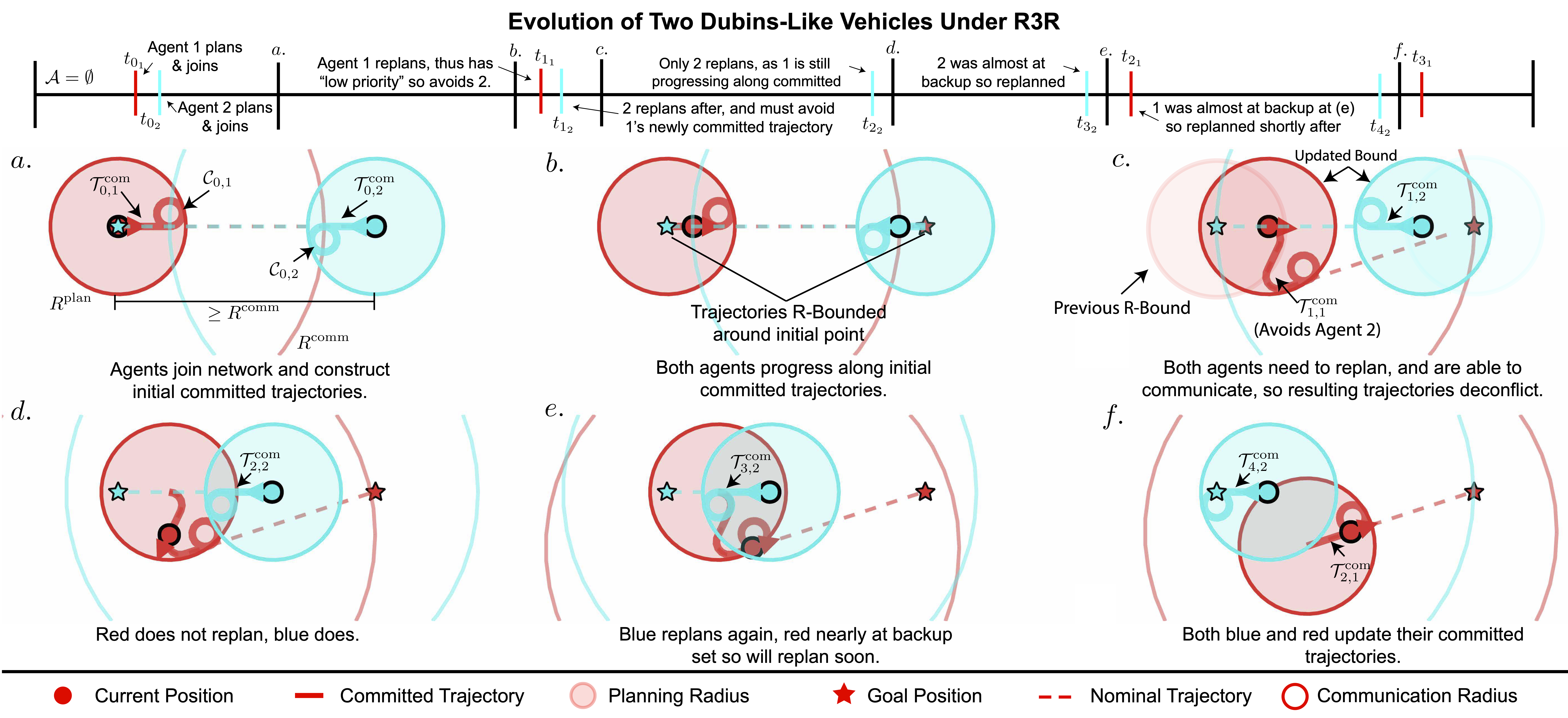
- R3R: Decentralized Multi-Agent Collision Avoidance with Infinite-Horizon SafetyExisting decentralized methods for multi-agent motion planning lack formal, infinite-horizon safety guarantees, especially for communication-constrained systems. We present R3R, to our knowledge the first decentralized and asynchronous framework for multi-agent motion planning under distancebased communication constraints with infinite-horizon safety guarantees for systems of nonlinear agents. R3R’s novelty lies in combining our gatekeeper safety framework with a geometric constraint called R-Boundedness, which together establish a formal link between an agent’s communication radius and its ability to plan safely. We constrain trajectories to within a fixed planning radius that is a function of the agent’s communication radius, which enables trajectories to be shown provably safe for all time, using only local information. Our algorithm is fully asynchronous, and ensures the forward invariance of these guarantees even in time-varying networks where agents asynchronously join, leave, and replan. We validate our approach in simulations of up to 128 Dubins vehicles, demonstrating 100% safety in dense, obstacle rich scenarios. Our results demonstrate that R3R’s performance scales with agent density rather than problem size, providing a practical solution for scalable and provably safe multi-agent systems.
- How to Adapt Control Barrier Functions? A Learning-Based Approach with Applications to a VTOL QuadplaneIEEE CDC 2025
abstract / project page / code / web demo / arxiv /In this paper, we present a novel theoretical framework for online adaptation of Control Barrier Function (CBF) parameters, i.e., of the class K functions included in the CBF condition, under input constraints. We introduce the concept of locally validated CBF parameters, which are adapted online to guarantee finite-horizon safety, based on conditions derived from Nagumo's theorem and tangent cone analysis. To identify these parameters online, we integrate a learning-based approach with an uncertainty-aware verification process that account for both epistemic and aleatoric uncertainties inherent in neural network predictions. Our method is demonstrated on a VTOL quadplane model during challenging transition and landing maneuvers, showcasing enhanced performance while maintaining safety.